
What Is Hashrate and Why Does It Matter?
Introduction
If you spend any time around Bitcoin miners, you’ll hear the word hashrate come up constantly. It’s one of the most important numbers in the mining world, but it can also feel confusing at first.
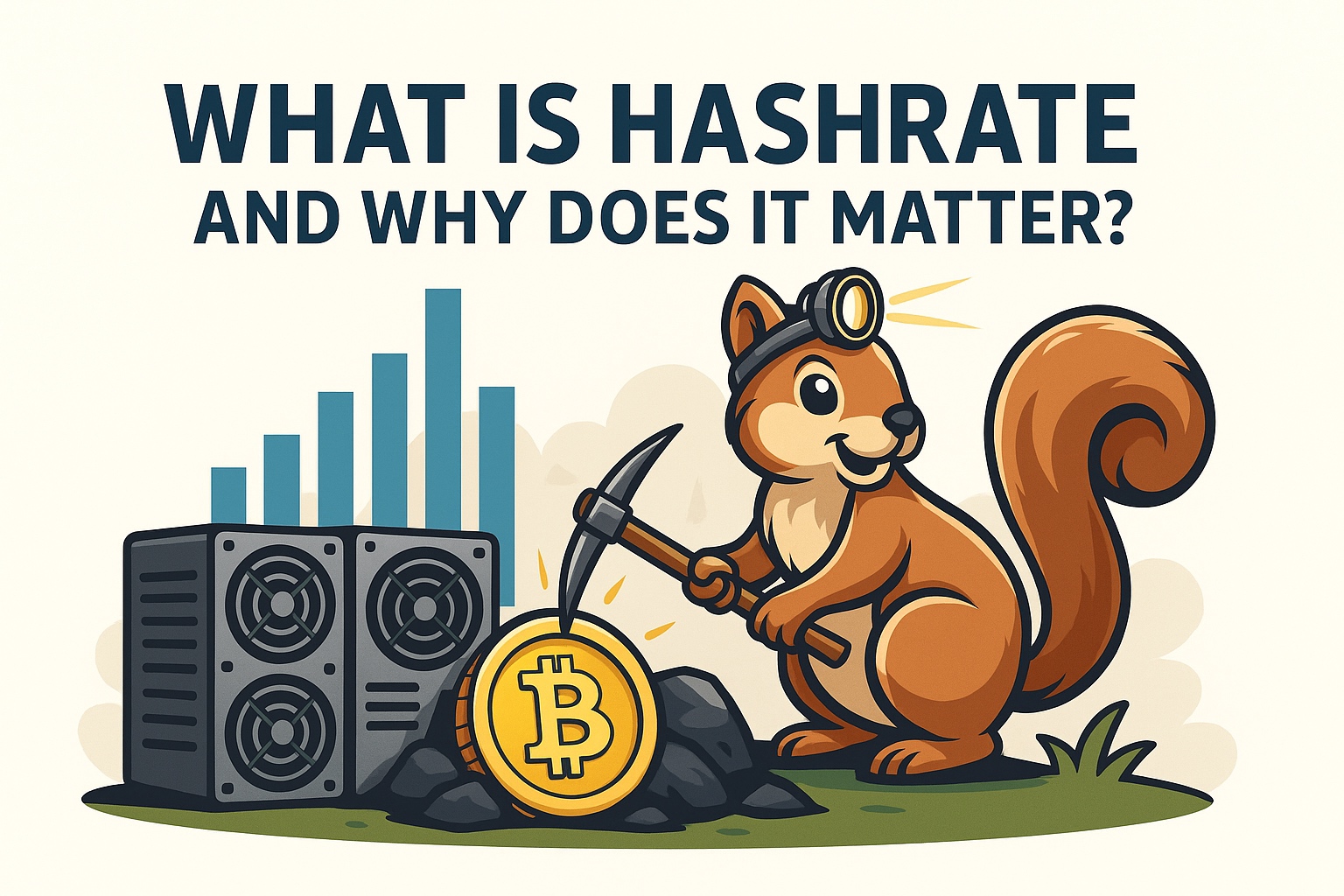
At Florida Mining Solutions, we believe every miner (and crypto enthusiast) should understand what hashrate means and why it matters. With a little help from our mascot, Satoshi Squirrel, let’s break it down in relatable, squirrel-approved terms. 🐿️
What Is Hashrate?
In simple terms, hashrate is the speed at which a mining machine can solve Bitcoin’s cryptographic puzzles.
- A “hash” is a single attempt (or guess) to solve the puzzle.
- Hashrate measures how many guesses a miner makes every second.
For example:
A machine running at 200 terahashes per second (TH/s) makes 200 trillion guesses every second.
That’s a lot of nut locks to crack.
The Squirrel Analogy
Imagine a forest full of squirrels trying to open puzzle boxes that hide acorns inside. Each squirrel rattles off guesses: “Is it 1234? Nope. 5678? Nope.” The faster the squirrel guesses, the more likely it is to crack the box before the others.
Hashrate is squirrel speed — how many guesses a squirrel (miner) can make per second.
Individual Hashrate vs. Network Hashrate
There are two important perspectives:
Your Miner’s Hashrate
- This is how fast your machine guesses the puzzle.
- Higher hashrate = better odds of earning rewards.
Network Hashrate
- The combined power of all miners worldwide.
- The bigger the network hashrate, the stronger and more secure the Bitcoin network becomes.
Analogy: It’s the difference between one squirrel racing vs. the whole forest working together.
Why Hashrate Matters for Miners
For miners like us, hashrate is a measure of both performance and profitability.
- Higher hashrate = more chances to win block rewards.
- More efficient hashrate = more rewards per unit of energy (important for ROI).
- Comparisons across miners: The S21+ produces more hashrate than an Avalon Q, which is why it’s more powerful — but it also consumes more power.
Why Hashrate Matters for Bitcoin
For the Bitcoin network itself, hashrate is about security and trust.
- The higher the hashrate, the harder it is for any bad actor to attack the network.
- It would take more computing power than the rest of the entire network combined to rewrite history — something practically impossible when hashrate is high.
- In other words: more squirrels guessing makes it impossible for one sneaky squirrel to cheat the system.
This is why you’ll often see hashrate described as the backbone of Bitcoin’s security.
Hashrate and Difficulty: The Balancing Act
Hashrate also interacts with difficulty (another key mining concept we’ll cover in detail in Post #4).
- If the network hashrate increases, Bitcoin raises difficulty so blocks don’t get mined too fast.
- If miners leave, difficulty decreases to keep the schedule on track.
Think of it like the forest getting thicker or thinner depending on how many squirrels are scurrying around.
Hashrate Growth Over Time
In Bitcoin’s early days, miners used laptops and had hashrates measured in kilohashes per second (KH/s).
Today, we’re talking in terahashes per second (TH/s) — trillions of guesses per second — thanks to ASIC technology. This exponential growth in hashrate shows both how competitive mining has become and how secure the network now is.
Challenges With Hashrate
- Energy Costs: High hashrate machines consume lots of electricity. Efficiency is the balancing act.
- Heat & Noise: More power = more heat, which needs cooling.
- Arms Race: As hashrate rises, miners constantly upgrade equipment to stay competitive.
But these challenges are part of what makes Bitcoin decentralized and secure.
The Future of Hashrate
Experts expect Bitcoin’s global hashrate to keep growing — even through halving events — as miners innovate and find more efficient ways to run their rigs.
Some predict that hashrate will become a measure not only of network security but also of energy innovation, as miners tap into stranded energy, renewables, and smarter grid balancing.
Conclusion
Hashrate might sound technical, but it’s simply the speed of guesses. For miners, it’s the measure of performance. For Bitcoin, it’s the foundation of security.
And in the words of our squirrel guide:
Satoshi Says: “Hashrate is squirrel speed. The faster you hash, the closer you get to the nut.” 🐿️
So the next time you see hashrate numbers on a dashboard or hear miners bragging about their TH/s, you’ll know exactly what they’re talking about — and why it matters.
Author

Tags: mining, sotoshi squirrel

Recent Comments