
Why Miners Secure the Network
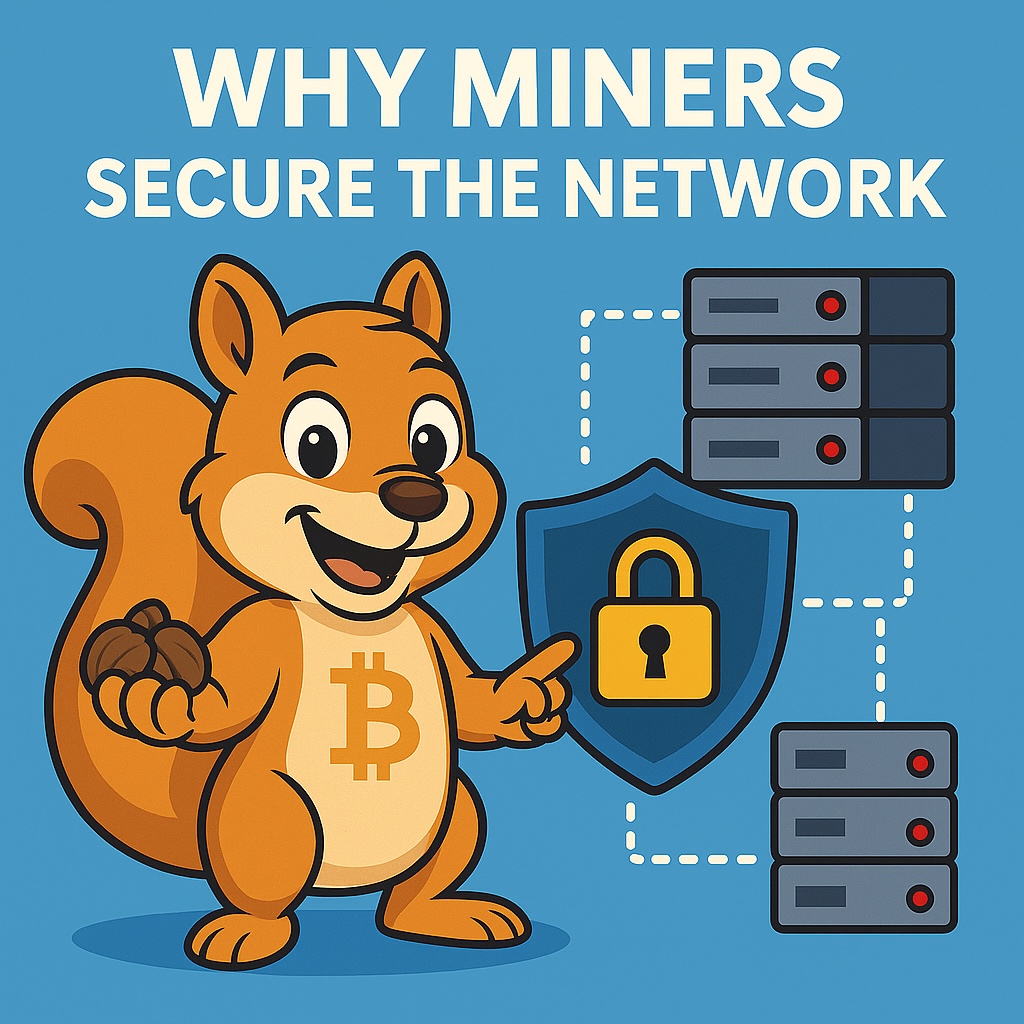
🔐 Why Miners Secure the Network
Cornerstone Educational Content
Introduction
When people first hear about Bitcoin mining, they often think miners are just “earning Bitcoin.” But that’s only part of the story.
In reality, miners play a much more important role:
they secure the entire Bitcoin network.
Every block mined, every hash computed, and every watt of energy spent contributes to keeping Bitcoin decentralized, trustworthy, and resistant to attack.
As Satoshi Squirrel would say:
“It’s not just about gathering nuts — it’s about guarding the tree.” 🐿️🌳
Let’s explore how miners secure the network, why proof-of-work matters, and why Bitcoin’s security grows stronger with every block.
What Does “Securing the Network” Mean?
At its core, Bitcoin is a ledger — a public record of transactions. But unlike traditional ledgers kept by banks or governments, Bitcoin’s ledger is protected by math, energy, and decentralization.
Securing the network means:
- Ensuring transactions can’t be altered after confirmation
- Preventing double-spending
- Making attacks extremely expensive and impractical
- Keeping Bitcoin independent from centralized control
Miners are the guardians that make all of this possible. If you haven’t read our Mining 101 post yet, that would be a good place to start.
The Role of Miners in Bitcoin
Miners do three essential things:
1️⃣ Validate Transactions
When you send Bitcoin, that transaction enters a public waiting area called the mempool.
Miners:
- Verify the transaction is valid
- Confirm the sender has sufficient balance
- Ensure the transaction follows Bitcoin’s rules
Only valid transactions make it into a block.
2️⃣ Create New Blocks
Miners bundle verified transactions into blocks and compete to add the next block to the blockchain.
This competition is based on proof-of-work — a process that requires massive computational effort.
Whoever solves the puzzle first:
- Adds the next block
- Receives the block reward
- Secures the network one block further
3️⃣ Lock In History
Once a block is added, it becomes part of Bitcoin’s permanent history.
Each new block reinforces the ones before it — making older transactions exponentially harder to change.
This is why Bitcoin is often described as immutable.
Satoshi Says: “Every new ring in the tree makes the trunk stronger.” 🌳🐿️
Proof-of-Work: The Foundation of Security
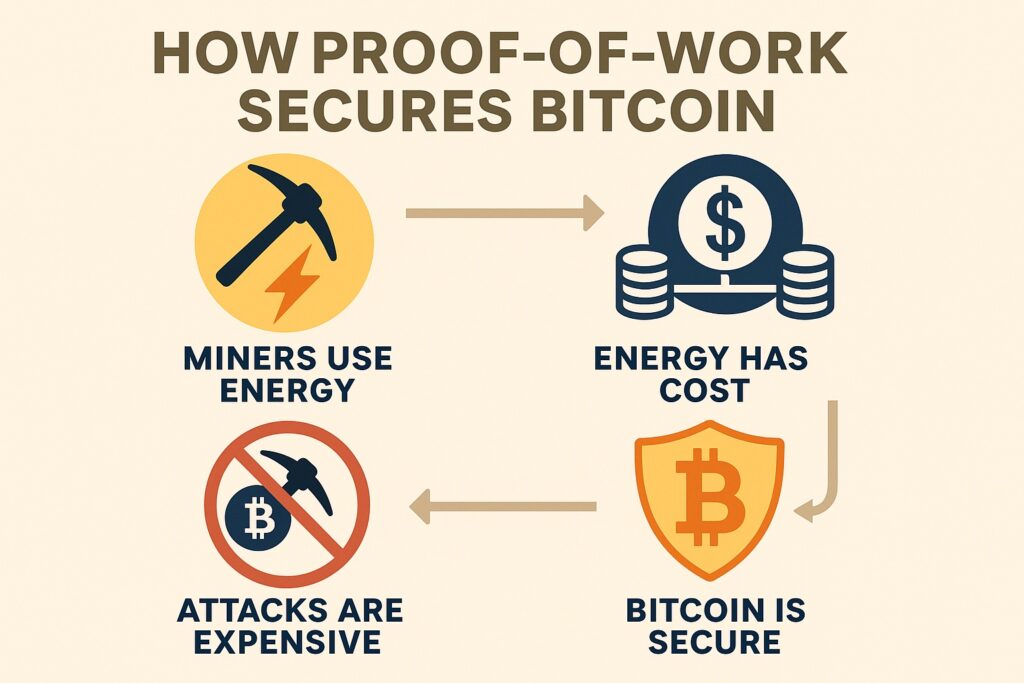
Proof-of-work (PoW) is what makes Bitcoin secure — and what makes attacks so difficult.
Here’s why it matters:
- Mining requires real-world energy
- Energy has real-world cost
- Attacking Bitcoin would require enormous resources
To rewrite Bitcoin’s history, an attacker would need to:
- Control more than 50% of the total network hashrate
- Sustain that control for long enough to outrun honest miners
- Spend billions in hardware and electricity
And even then — the attack would likely fail or be noticed immediately.
In short:
Bitcoin is secure because it’s expensive to attack.
Why Decentralization Is Critical
Unlike traditional systems, Bitcoin has:
- No central authority
- No master server
- No single point of failure
Miners are distributed across:
- Countries
- Power grids
- Climates
- Political systems
This global decentralization makes Bitcoin resilient.
Even if miners in one region go offline, the network adjusts and continues — something no centralized system can do.
Satoshi Says: “A forest guarded by many squirrels is harder to conquer.” 🐿️🌲
Hashrate = Security
Hashrate is the total computing power securing Bitcoin.
Higher hashrate means:
- More energy protecting the network
- Higher cost to attack
- Stronger resistance to manipulation
When new miners join the network, security increases automatically.
That’s why rising hashrate is often seen as a sign of Bitcoin’s health and confidence. You should see your hashrate in your dashboard.
Why Miners Are Incentivized to Be Honest
Bitcoin’s design aligns incentives beautifully.
Miners earn Bitcoin by:
- Following the rules
- Securing the network
- Competing fairly
Dishonest behavior leads to:
- Rejected blocks
- Wasted energy
- Financial loss
Honest mining is always the most profitable path.
This incentive alignment is one of Bitcoin’s greatest innovations — it turns self-interest into collective security.
Energy Use: A Feature, Not a Bug
Bitcoin mining uses energy — and that’s intentional.
Energy consumption:
- Anchors Bitcoin to the physical world
- Makes attacks costly
- Prevents “free” manipulation
Much like building a vault requires steel and concrete, securing Bitcoin requires electricity and computation.
Increasingly, miners also:
- Use stranded or excess energy
- Stabilize power grids
- Incentivize renewable development
Satoshi Says: “Strong walls need strong materials.” 🐿️⚡
How Your Miner Helps Secure Bitcoin
Even a single miner contributes to security.
When your rig runs:
- It adds hashrate
- It participates in block creation
- It strengthens decentralization
Your miner is one more honest participant in a global system that runs without permission.
That’s powerful.
Mining isn’t just about rewards — it’s about participation in protecting the network.
What Happens If Miners Stop Mining?
If miners leave the network:
- Difficulty adjusts downward
- Remaining miners continue
- Blocks keep coming
Bitcoin is designed to survive miner turnover.
Security scales up and down automatically — a remarkable feature that allows Bitcoin to persist across decades, technologies, and economic cycles.
Why This Matters Long-Term
Bitcoin’s long-term value depends on:
- Trust
- Security
- Immutability
Miners provide all three.
As block rewards decrease through halvings, transaction fees and efficiency will play a bigger role — but the fundamental mission remains the same:
Miners secure Bitcoin.
Satoshi Says: “The treasure lasts because the guards never leave.” 🐿️🔐
Conclusion
Bitcoin doesn’t rely on trust — it relies on proof.
Proof of work. Proof of energy. Proof of honesty.
Miners are the silent guardians of the network, turning electricity into security and computation into confidence.
Every block, every hash, every watt strengthens the chain.
Whether you run one miner or thousands, you’re not just earning Bitcoin — you’re helping protect the most decentralized monetary system ever created.
And that’s something worth guarding.
Author

Tags: mining
Recent Comments