
How Mining Helps Decentralization
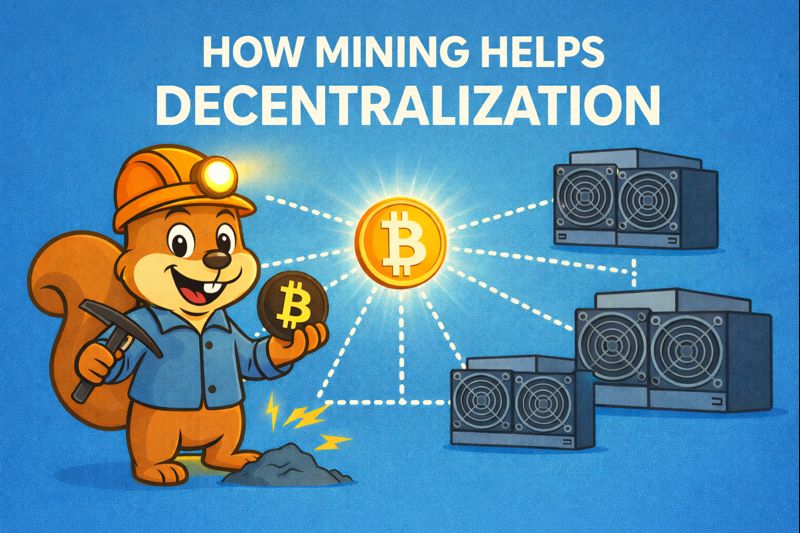
Decentralization isn’t just a buzzword in Bitcoin—it’s the entire point.
Without decentralization, Bitcoin would just be another digital system controlled by a handful of powerful players. Mining is the mechanism that prevents that from happening.
Let’s break down how Bitcoin mining actively protects decentralization—and why that matters more than ever.
🌍 Decentralization Starts With Distribution
At its core, decentralization means:
- No single owner
- No central control
- No permission required to participate
Bitcoin mining is open to anyone, anywhere with:
- Hardware
- Electricity
- An internet connection
There’s no application, license, or approval process. This openness ensures that no single company, government, or cartel can control the network.
⛏️ Mining Turns Power Into Competition (Not Control)
Mining is competitive by design.
Every miner:
- Competes to find the next block
- Follows the same transparent rules
- Gets rewarded only if they play fair
If a miner tries to cheat:
- The network rejects their block
- They lose money
- Honest miners continue
This creates a powerful incentive structure where honesty wins, not authority.
🔄 Why Proof of Work Matters
Bitcoin uses Proof of Work, which requires real-world energy to secure the network.
That matters because:
- Energy is hard to fake
- Work must be proven, not claimed
- Control requires massive, sustained cost
Unlike systems based on identity, reputation, or stake, Proof of Work ensures that influence must be earned continuously, not granted once.
🐿️ Satoshi Says…
“If mining were easy to fake, control would follow.
But when work must be proven,
trust becomes unnecessary.”
— Satoshi the Squirrel
This is the heart of Bitcoin mining:
don’t trust—verify.
🏗️ Mining Prevents Central Points of Failure
Centralized systems fail in predictable ways:
- Policy changes
- Shutdowns
- Censorship
- Single points of attack
Bitcoin mining is globally distributed across:
- Countries
- Power grids
- Operators
- Hardware types
If miners go offline in one region, others keep the network running.
There is no off switch.
⚡ Small Miners Matter (A Lot)
Decentralization isn’t just about size—it’s about diversity.
Thousands of small and mid-sized miners:
- Add geographic resilience
- Reduce concentration risk
- Strengthen censorship resistance
At Florida Mining Solutions, we believe:
Every honest miner—big or small—makes the network stronger.
🔐 Mining Enforces the Rules (Without Asking Permission)
Bitcoin’s rules don’t change because someone wants them to.
Mining enforces:
- The 21 million supply cap
- Transaction validity
- Block timing
- Consensus integrity
Miners don’t decide the rules—they enforce the rules users already agree on. That separation of power is what keeps Bitcoin decentralized.
🌱 Decentralization Is a Process, Not a Destination
Bitcoin isn’t “perfectly decentralized”—and that’s okay.
Decentralization is something that:
- Strengthens over time
- Responds to incentives
- Improves through participation
Every new miner, node, and independent operator pushes Bitcoin further away from control and closer to resilience.
🟠 Final Takeaway
Mining isn’t just about earning Bitcoin.
It’s about:
- Protecting neutrality
- Preventing capture
- Keeping the network open
- Turning energy into security
Bitcoin stays decentralized because miners keep showing up and doing the work.
Author

Tags: mining
Recent Comments