
A Day in the Life of My Mining Setup
Introduction
If you’ve ever wondered what life looks like behind the hum of a Bitcoin mining operation, this one’s for you.
While some people start their mornings with coffee and emails, my day starts with the faint whir of fans — the sound of my Antminer S21+ and four Avalon Qs working hard to secure the Bitcoin network. If you missed how this setup came together, check out Adding Four Avalon Qs: What Changed?
It’s not glamorous. It’s not silent. But it’s deeply rewarding — a blend of routine, curiosity, and constant fine-tuning that keeps everything running efficiently.
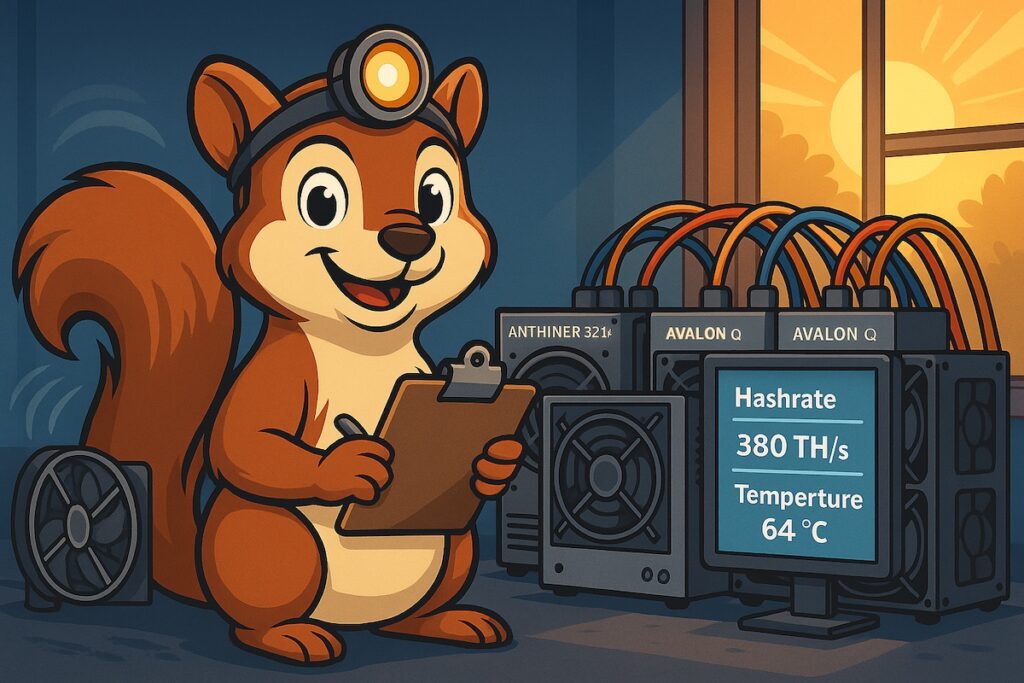
This is a glimpse into a day in the life of my mining setup here in sunny, humid Florida — where even the squirrels know to plan for the heat. ☀️🐿️
Morning: Check-In and Status Sweep ☕
My first stop each morning is the dashboard. Before emails or phone calls, I check on:
Hashrate performance (is it steady overnight?)
Temperature logs (did any rigs run hot?)
Uptime reports (did any miner go offline?)
It’s the miner’s equivalent of checking a flight panel before takeoff — making sure all systems are “go.”
If I see a dip in hashrate, I investigate. Sometimes it’s nothing more than a pool fluctuation. Other times, it’s a sign a rig is throttling itself due to rising temperatures.
When that happens, I’ll step into the mining room to do a quick visual and audio check — listening for fans that sound strained or air that’s not flowing right. You can tell a lot from the sound of your machines once you know what “normal” sounds like.
Satoshi Says: “Every hum tells a story — you just have to listen.” 🐿️🎧
Mid-Morning: Environmental Control 🌡️
By mid-morning, Florida’s heat starts to build, and that means one thing: airflow management.
My setup includes:
Two intake fans pulling in filtered, cooler air.
Inline exhaust fans venting hot air outside.
Temperature and humidity sensors feeding data to a dashboard.
Even a few degrees of ambient change can affect performance, so I check that all fans are running at proper speed and that air paths remain clear. I learned just how big a difference airflow makes in Mining and Heat: Why Cooling Is King
Dust is an ever-present enemy here, so once a week I’ll take a few minutes to inspect filters and blow off minor buildup with compressed air. Keeping airflow clean means less stress on fans and lower power use overall.
Afternoon: Power and Network Review ⚡
Afternoons are when I review power metrics and network stability.
Running five miners continuously draws around 9 kW of power — so it’s critical to know how efficiently that power is being used. My smart PDU lets me:
Monitor real-time draw per circuit.
Spot any irregular consumption.
Remotely restart devices if needed.
Then comes network testing. After adding my Avalon Qs, I learned that network load can quietly affect performance — and even cause VoIP packet loss (yes, that infamous phone system issue). That issue turned into its own project — read more in How I Balanced Bitcoin Mining With VoIP
Since I implemented traffic shaping, I check that the QoS rules are still holding:
VoIP gets top priority.
Mining traffic flows smoothly behind it.
Now I can mine without missing a single clear phone call.
Satoshi Says: “When packets collide, somebody loses their nuts.” 🐿️📞
Mid-Afternoon: Maintenance and Cleaning 🧰
This is the time of day when I handle minor maintenance tasks — the things that keep the forest running smoothly before small issues become big ones.
Routine checks include:
Dust inspection: even with filters, Florida air finds a way.
Cables and connectors: ensure nothing’s loose or strained.
Noise levels: unusual changes can hint at fan wear or imbalance.
Firmware updates: apply cautiously — always one rig at a time.
I also like to use this time to log key performance stats.
Recording efficiency, uptime, and temperature ranges helps me spot trends. If one rig consistently runs hotter or slower, I can address it proactively.
Evening: Cooling Down and Analysis 🌇
By evening, the Florida sun has done its work, and temperatures start to cool — but the miners are still at full throttle.
This is my time to reflect and review:
Pool payouts (did everything calculate correctly?)
Efficiency comparisons (S21+ vs. Avalon Qs)
Noise and temperature deltas (did the day’s heat impact anything long-term?)
This is where the “scientist” side of mining shines. Each data point tells a story — a clue about how to make tomorrow’s performance a little better.
Sometimes I’ll test small tweaks, like slightly adjusting fan curves or repositioning intake filters. Other days, I’ll just sit back, listen to the hum, and enjoy the satisfaction of knowing everything’s running smoothly.
Night: Security and Shutdown (Sort Of) 🌙
Mining doesn’t sleep, but I do — so before turning in, I make sure everything is secure:
Remote access locked down.
Monitoring alerts enabled (for downtime, temperature spikes, or power issues).
Cameras on the mining area (optional, but peace of mind goes a long way).
I’ll glance one last time at the dashboard — seeing the steady hashrate and clean temps feels like a goodnight lullaby.
Then I close the door on the hum and head inside, knowing the rigs will work tirelessly through the night.
Satoshi Says: “When you rest, your miners don’t — that’s the beauty of proof-of-work.” 🐿️💤
Lessons from the Daily Routine
Mining may sound automated, but it’s far from “set it and forget it.” It’s an evolving balance of:
Hardware care: heat, dust, and noise control.
Energy management: optimizing every watt.
Network reliability: keeping data flowing smoothly.
Data insight: using trends to stay ahead of problems.
It’s also deeply satisfying — seeing the results of your efforts not just in Bitcoin earned, but in the stability and precision of a system you built.
Conclusion
A day in the life of my mining setup is a blend of work and wonder — machines running in perfect sync, lessons learned from small tweaks, and the occasional adventure in bandwidth control.
It’s proof that Bitcoin mining isn’t just about machines; it’s about understanding systems, staying curious, and always looking for ways to improve.
As Satoshi Squirrel says:
“Mining is more than digging for acorns — it’s caring for the whole forest.” 🐿️🌳

Recent Comments