
Efficiency: More Nuts, Less Energy
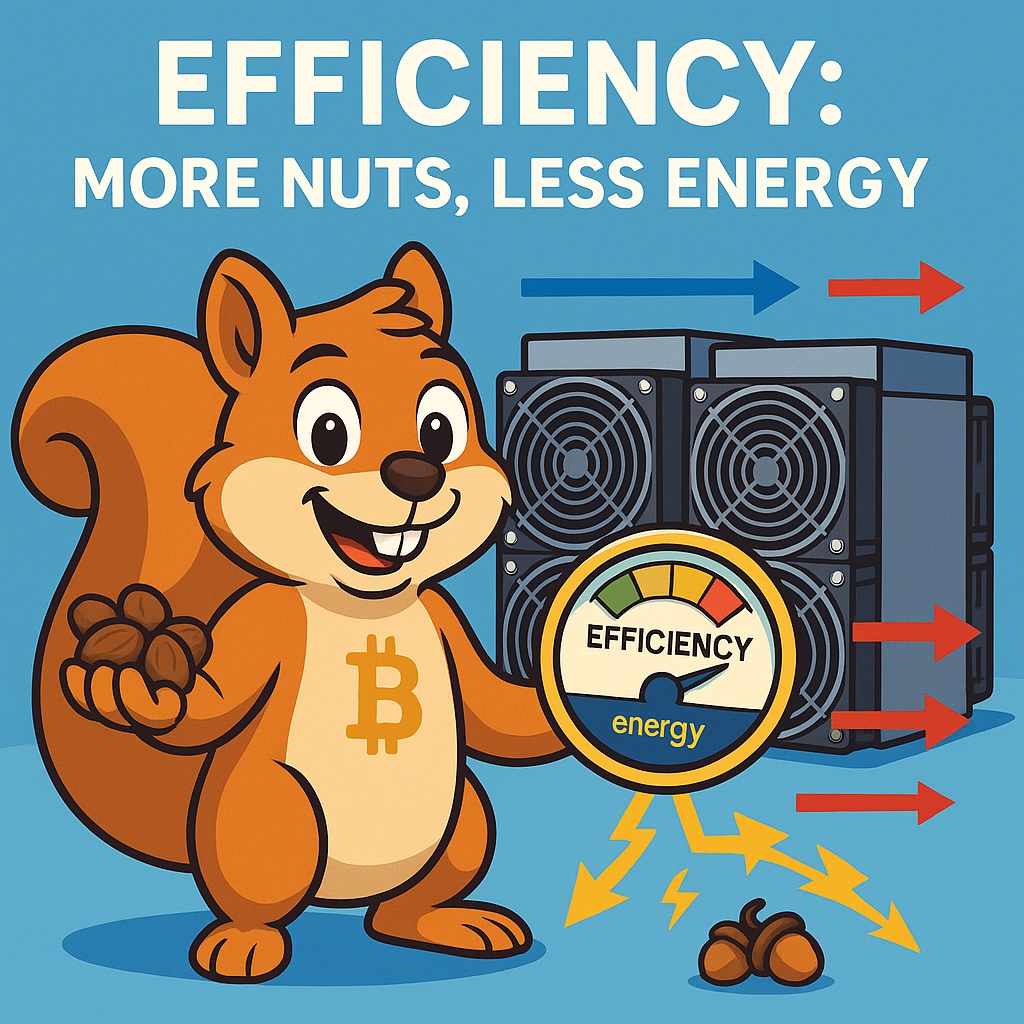
🥜 Efficiency: More Nuts, Less Energy
How Smarter Mining Saves Power, Reduces Heat, and Boosts Rewards
If Bitcoin mining were a forest adventure, efficiency would be the art of gathering more nuts while burning less energy doing it. And in real mining, just like in the wild, the miners who make the most of what they have tend to thrive the longest.
Efficiency is one of the most misunderstood concepts for new miners — yet it’s one of the most important if you want your rigs to run cooler, cheaper, and more profitably.
Today we’re breaking it all down, Satoshi Squirrel–style. 🐿️⚡
🌡️ What Efficiency Actually Means in Bitcoin Mining
When miners talk about “efficiency,” they usually mean how much energy your miner must consume to produce a certain amount of hashrate.
In simple terms:
Efficiency = How many watts your miner uses per terahash (W/TH).
It’s the mining equivalent of how many nuts Satoshi can gather before getting tired.
Lower W/TH = more efficient = more nuts for less effort.
⚙️ Why Efficiency Matters (More Than Ever)
With difficulty increasing and block rewards halving every four years, efficiency becomes the currency of survival. Here’s why:
✔ 1. Lower Energy Costs
For most miners, electricity is the #1 expense.
More efficiency = less power = smaller electric bill.
This is especially true in Florida, where A/C and ventilation already work overtime.
✔ 2. Less Heat → Longer Hardware Lifespan
Every watt your miner uses becomes heat.
More efficiency = cooler rigs
Cooler rigs = quieter fans, fewer failures, longer life.
Your future self will thank you.
✔ 3. Better Profitability in Tough Market Cycles
When Bitcoin dips or difficulty spikes, efficient miners keep earning while inefficient miners tap out.
Think of it like a heat wave in the forest — the squirrels with the best systems keep gathering.
🔌 Comparing Efficiency: S21+ vs Avalon Q Series
Let’s put real numbers to it.
Antminer S21+
~17.5 J/TH (super efficient)Avalon A15 / Avalon Q
~20–30 J/TH (varies by model)
Even though the Avalons aren’t the lightest on power, they are rock-solid and stable — a perfect supporting cast to an S21+ king miner.
But collectively, your setup still benefits from:
✔ Balanced airflow
✔ Lower power-per-TH compared to older rigs
✔ Excellent uptime
This puts your farm comfortably in the efficient-mining zone.
🧠 How to Make ANY Miner More Efficient (Squirrel-Approved Tips)
Here are practical ways to squeeze more “nuts” (hashrate) from every watt.
1. Undervolt Without Underperforming
Many rigs allow underclocking or voltage tuning.
A small decrease in output can often reduce watts significantly.
2. Perfect Your Airflow
Hot miners work harder → use more watts → generate less stable hashrate.
Cross-link:
👉 Cooling is King: Why Every Miner Needs a Solid Ventilation Plan
3. Keep Filters Clean
Dust = heat.
Heat = inefficiency.
Clean filters regularly and you’ll regain lost performance instantly.
4. Avoid Overloading Circuits
Voltage drops on overloaded lines force miners to work harder.
Keep each rig on a healthy power circuit with headroom.
5. Use High-Efficiency PSUs
A platinum-rated PSU reduces wasted electricity and heat.
That’s free nuts right there. 🥜
📉 How Efficiency Impacts Profitability (Simple Math)
Let’s say two miners each run at 200 TH/s:
| Miner | Watts Used | Efficiency | Power Cost @ $0.12/kWh |
|---|---|---|---|
| Miner A | 3500W | 17.5 J/TH | ~$302/mo |
| Miner B | 4500W | 22.5 J/TH | ~$388/mo |
That’s a $86/month difference on a single miner.
Multiply that across a year, or a small farm, and efficiency becomes a game-changer.
🧺 Satoshi’s Efficiency Rule of Thumb
“If your miner runs cool and steady, your energy bill stays ready.”
More nuts. Less energy. Longer hardware life.
That’s the efficiency trifecta.


Recent Comments