
Mining Difficulty — The Forest Gets Thicker
- by Staff
- in Uncategorized
- on September 23, 2025
Introduction
One of Bitcoin’s most brilliant features is how it stays steady and reliable no matter how many miners are competing. This is possible thanks to something called mining difficulty.
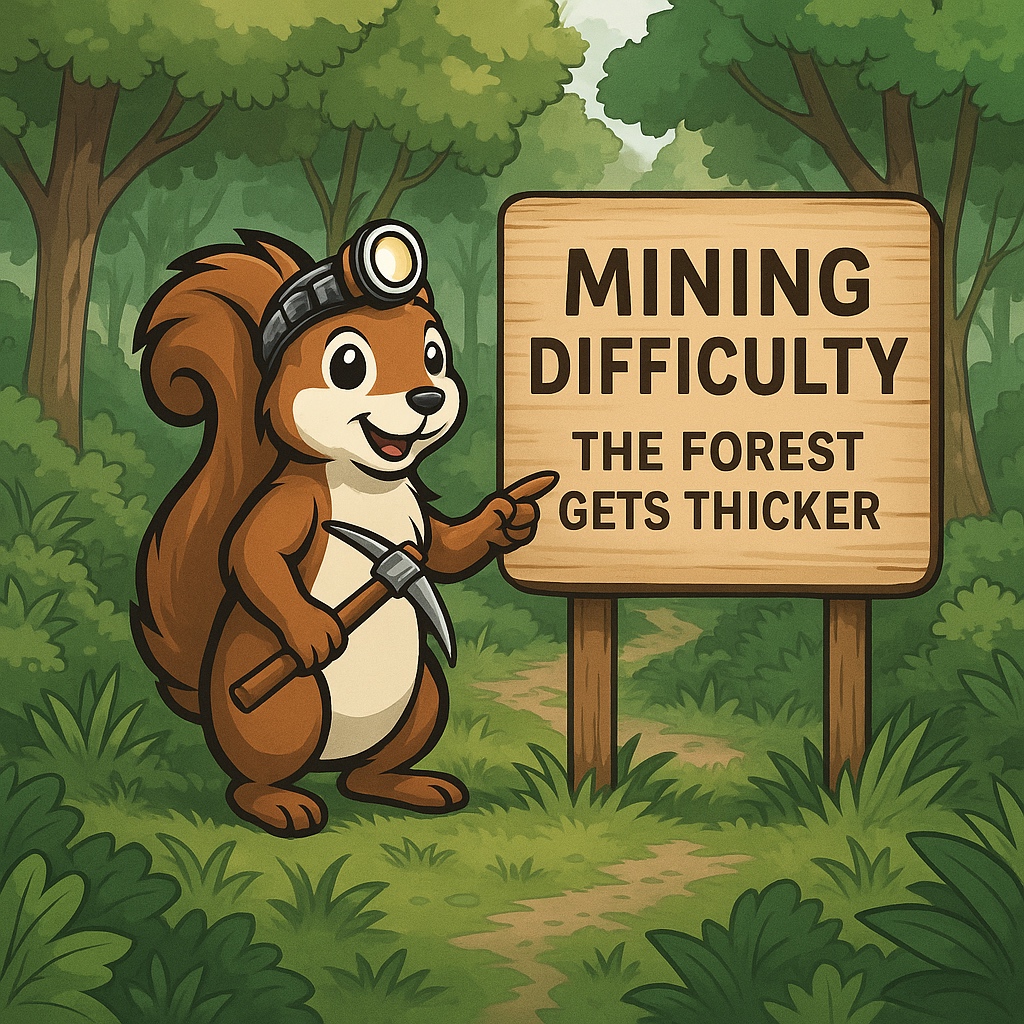
If you’ve ever wondered why difficulty matters — or how it automatically adjusts — you’re in the right place. Let’s explore this concept with the help of our mascot, Satoshi Squirrel, who knows a thing or two about forests and foraging. 🐿️
What Is Mining Difficulty?
Mining difficulty is the measure of how hard it is for miners to solve Bitcoin’s proof-of-work puzzle.
- High difficulty = puzzles are harder, requiring more guesses.
- Low difficulty = puzzles are easier, requiring fewer guesses.
The purpose of difficulty is to keep Bitcoin’s block creation rate steady at about one block every 10 minutes.
The Squirrel Analogy
Imagine a forest full of squirrels searching for hidden nut stashes.
- If lots of squirrels are scurrying around, the forest magically grows thicker, making nuts harder to find.
- If only a few squirrels remain, the forest thins out, making nuts easier to spot.
That’s Bitcoin difficulty in action — the forest adapts to keep nut-finding (block creation) on schedule.
How Does Difficulty Adjust?
Bitcoin has a built-in system that adjusts difficulty every 2,016 blocks — roughly every two weeks.
- If blocks are being found faster than 10 minutes each, difficulty increases.
- If blocks are being found slower than 10 minutes each, difficulty decreases.
This adjustment ensures Bitcoin stays predictable, regardless of how many miners join or leave the network.
Why Difficulty Matters for Miners
For individual miners, difficulty affects how likely you are to earn rewards.
- When difficulty rises, your machines need to work harder to earn the same rewards.
- When difficulty falls, it’s like the forest clearing out — your chances improve.
This is why miners closely watch difficulty charts — they directly impact profitability.
Why Difficulty Matters for Bitcoin
For the Bitcoin network, difficulty is what keeps things balanced.
- Ensures new blocks arrive about every 10 minutes.
- Maintains the scarcity and predictability of Bitcoin’s supply.
- Protects against sudden changes in mining power (for example, if many miners switch off after a halving or energy cost spike).
In other words, difficulty is Bitcoin’s self-balancing mechanism.
Historical Examples
Difficulty has increased dramatically since Bitcoin’s early days:
- In 2009, difficulty was so low that anyone with a laptop could mine.
- By 2025, difficulty has reached levels so high that only specialized ASIC miners stand a chance.
This growth reflects both the competitiveness of mining and the incredible strength of the Bitcoin network.
Difficulty and Halving: A One-Two Punch
Difficulty works hand-in-hand with the halving.
- Halving reduces block rewards (fewer nuts dropping).
- Difficulty ensures blocks don’t get mined too fast (forest thickness).
Together, they keep Bitcoin predictable, scarce, and valuable.
Challenges for Miners
Difficulty rising can be tough on small miners.
- Lower payouts: More hashrate across the network means your share shrinks.
- Upgrade pressure: Miners often need newer, more efficient machines to stay competitive.
- Market swings: Bitcoin price + difficulty determine whether mining is profitable.
But difficulty is also why Bitcoin is secure. Without it, the network could be manipulated or become unstable.
The Future of Difficulty
As more miners join, difficulty will continue to rise. This is both a challenge and a strength:
- Challenge: Individual miners must constantly adapt.
- Strength: The Bitcoin network becomes more resilient with every increase.
Difficulty is one of the reasons Bitcoin has never been hacked or successfully counterfeited — it’s simply too expensive to cheat.
Conclusion
Mining difficulty may sound complex, but it’s really just Bitcoin’s way of staying balanced.
- More miners = higher difficulty.
- Fewer miners = lower difficulty.
- Always one block every 10 minutes.
Or as Satoshi Squirrel says:
“The forest always adapts. Difficulty keeps the stash steady.” 🐿️
For miners, difficulty is the invisible force shaping rewards and profitability. For Bitcoin, it’s the secret ingredient that keeps the system reliable and secure.
Author

Tags: mining

Recent Comments