
My First Rig: Antminer S21+ in Florida Heat
Introduction
There’s something special about setting up your first mining rig. It’s a mix of excitement, curiosity, and just a touch of panic when you realize how much heat a single machine can produce.
For me, that moment came when I powered up my Antminer S21+ — a beast of a machine capable of incredible efficiency — and felt like I’d just opened the door to a blast furnace.
Welcome to mining in Florida, where the sunshine is free but the cooling bill isn’t. ☀️🐿️
Why the Antminer S21+
When I decided to expand my small mining setup, I wanted hardware that struck a balance between efficiency and performance. The S21+ quickly stood out:
Hashrate: ~200 TH/s (depending on configuration)
Power efficiency: Around 17.5 J/TH — impressive for its class
Design: Compact but built for serious output
It’s the kind of machine that makes you appreciate how far ASIC technology has come — and how important planning your environment is before you plug it in.
“Power is nothing without airflow,” as Satoshi Squirrel wisely says.
The Florida Factor
Mining in Florida comes with unique challenges:
High humidity year-round
Ambient temperatures that make most miners sweat (literally)
Power rates that require efficiency to make long-term sense
That means one thing: ventilation and cooling are absolutely critical.
Step 1: Planning for Heat
Before I even turned on the S21+, I treated it like planning a miniature data center.
Here’s what I did:
Dedicated space: I set up the rig in a well-ventilated room separate from the main office area.
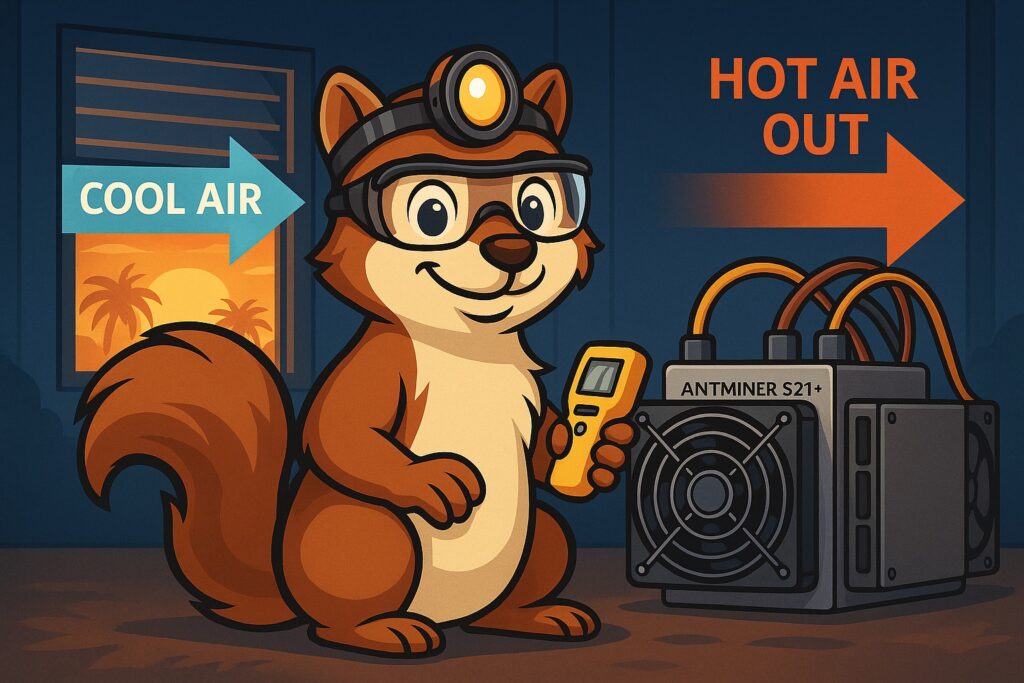
Intake and exhaust airflow: One side of the room pulls in filtered cool air, while the opposite side exhausts hot air outside using an inline fan system.
Temperature monitoring: I installed digital temperature sensors so I could track both ambient and exhaust temperatures remotely.
After a few days of trial and error, I realized every degree mattered. Keeping the ambient air around 80°F or lower made a noticeable difference in efficiency and fan speed.
Step 2: Noise Control
If you’ve never heard an S21+ spin up before — imagine a small jet engine in your living room.
To manage this, I:
Mounted soundproof panels around the mining area.
Used flexible ducting to move air directly outside, which reduced echo and back pressure.
Built a simple muffler box using MDF and insulation foam to dampen the fan noise (without restricting airflow).
The result?
It’s still loud — but no longer something that drowns out phone calls or scares off visitors.
Satoshi Says: “A quiet squirrel is a clever squirrel.” 🐿️🔇
Step 3: Power and Efficiency
Florida electricity costs mean every watt counts.
The S21+ draws roughly 3,500 watts under full load, so I made sure my circuit was built to handle it safely:
Dedicated 240V line rated above expected draw.
Quality PDU (power distribution unit) for monitoring usage.
Inline surge protection to prevent damage during storms (which are common here).
I also learned to watch for power factor — using a meter to make sure the system runs efficiently. If your power draw isn’t clean, you’re wasting money.
Step 4: Network Stability
Mining is surprisingly network-sensitive. Even though it uses very little bandwidth, packet loss or latency spikes can affect performance.
To keep my hashrate consistent:
I set up a separate VLAN just for miners.
Used static IPs to avoid DHCP hiccups.
Prioritized traffic so my VoIP calls wouldn’t suffer (that’s another story — see How I Balanced Bitcoin Mining With VoIP).
This ensured smooth operation even when other devices shared the network.
Step 5: Maintenance Routine
After the first week, I learned that dust and Florida humidity are relentless. My new checklist includes:
Weekly air filter cleaning.
Monthly miner inspection (look for corrosion or buildup).
Fan speed and temperature review through the control panel.
It’s a bit like maintaining a race car — small issues add up fast if ignored.
Lessons Learned
Plan for heat first. Cooling is more important than hashrate if you want long-term uptime.
Power safety is non-negotiable. Overloading circuits is asking for trouble.
Monitor constantly. Data logs tell you everything you need to know.
Noise control matters. Especially if your mining space doubles as a workspace.
Every environment is unique. What works in one climate might fail in another.
Reflections from the Florida Mining Front
The first few days with the Antminer S21+ were full of trial, error, and plenty of airflow adjustments. But by the end of week one, I had a stable, efficient, and surprisingly manageable setup.
And yes — it still gets hot.
But with the right planning, it’s a controlled kind of heat — the kind that signals progress, energy, and opportunity.
Closing Thoughts
Starting your first mining rig isn’t just about plugging in a machine. It’s about understanding your environment, optimizing every detail, and building something sustainable.
As Satoshi Squirrel would say:
“The smartest miners don’t just dig — they prepare their burrow.” 🐿️
Whether you’re mining in the Florida heat or the Arctic chill, preparation makes all the difference.
Author

Tags: mining

Recent Comments