
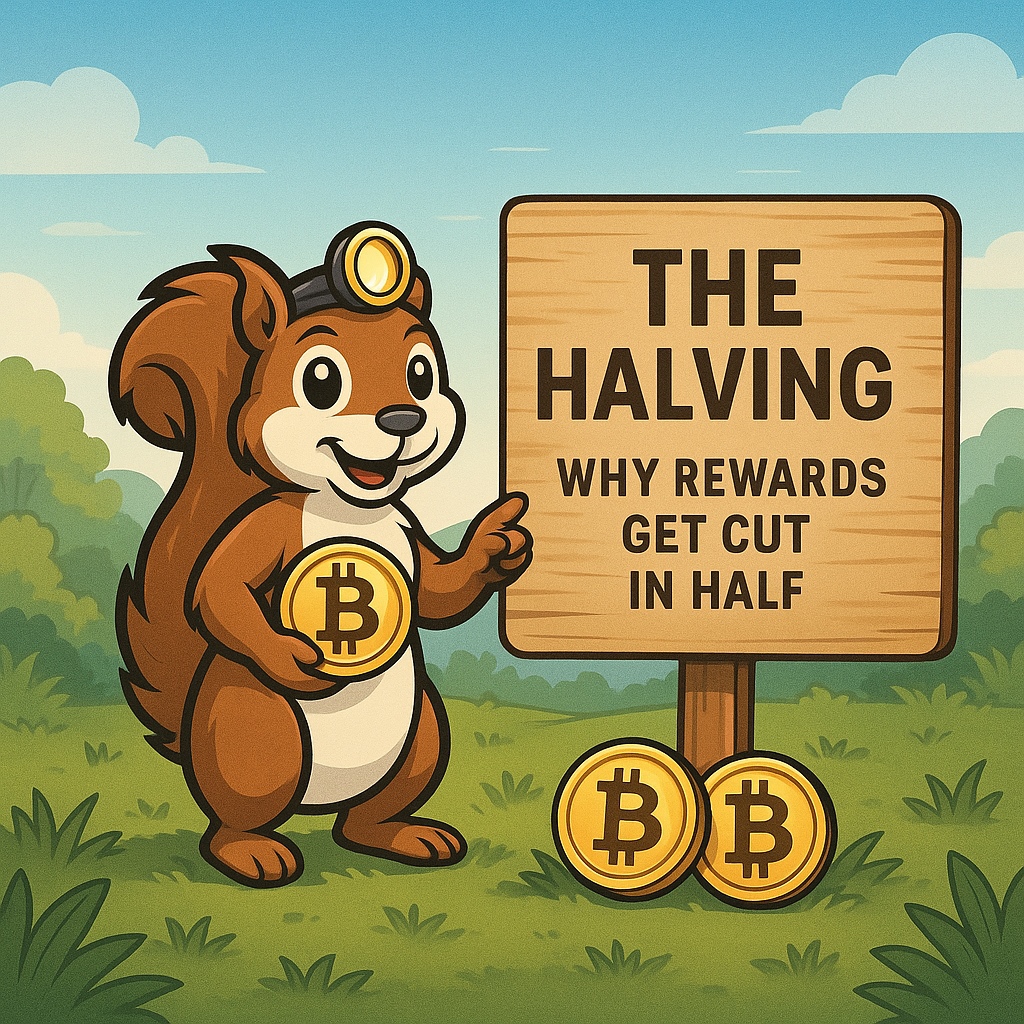
The Halving — Why Rewards Get Cut in Half
The Next Halving Countdown
Estimated halving date. Exact timing depends on block times.
Introduction
Every four years, Bitcoin miners face a major event: the halving. It’s not a bug — it’s part of Bitcoin’s design. The halving cuts the reward for mining new blocks in half, reducing the flow of new Bitcoin into circulation.
At first glance, that might sound discouraging for miners. But in reality, the halving is one of the most important reasons Bitcoin holds long-term value. Let’s explore why, with a little help from our mascot, Satoshi Squirrel. 🐿️
What Is the Halving?
The Bitcoin halving is a scheduled event that occurs every 210,000 blocks, or roughly every four years.
- When Bitcoin launched in 2009, block rewards were 50 BTC.
- By 2012, they dropped to 25 BTC.
- By 2016, they were 12.5 BTC.
- By 2020, 6.25 BTC.
- Today (2025), miners earn 3.125 BTC per block.
- In 2028, that will be cut again to 1.5625 BTC.
This process will continue until the last Bitcoin is mined around the year 2140.
The Squirrel Analogy
Imagine a mighty oak tree that drops acorns every day.
- In the beginning, the tree dropped 50 acorns a day.
- After a few seasons, it dropped 25.
- Then 12.5, and so on.
Squirrels may grumble at getting fewer acorns, but here’s the twist: since there are fewer acorns falling, each one becomes rarer and more valuable.
That’s the halving — fewer nuts, more scarcity.
Why Does the Halving Exist?
The halving is built into Bitcoin’s code to:
Control Supply
- Bitcoin’s total supply is capped at 21 million.
- The halving ensures new coins enter the system more slowly over time.
Create Scarcity
- Scarcity drives value.
- Just like gold becomes harder to mine over time, Bitcoin becomes harder to earn.
Protect the Network’s Longevity
- By slowing down rewards, Bitcoin ensures it won’t “run out” of coins too quickly.
- Miners will still earn transaction fees even after the last Bitcoin is mined.
Why the Halving Matters for Miners
On the surface, the halving cuts miners’ income in half. But it’s more nuanced than that:
- Short-term pain: Lower block rewards mean less Bitcoin for the same work.
- Long-term gain: Scarcity historically increases Bitcoin’s price, offsetting lower rewards.
- Market shakeout: Less efficient miners may drop out, lowering difficulty and giving efficient miners a better chance at rewards.
Why the Halving Matters for Bitcoin
The halving is a big deal not just for miners, but for Bitcoin as a whole.
- It signals Bitcoin’s commitment to scarcity and predictable supply.
- It creates excitement and attention around Bitcoin every four years.
- It has historically triggered major bull markets.
In fact, after each past halving, Bitcoin’s price rose dramatically within 12–18 months. While history doesn’t guarantee the future, many investors watch halving cycles closely.
Historical Halving Cycles
- 2012 Halving: Bitcoin rose from ~$12 to over $1,000 the following year.
- 2016 Halving: Price climbed from ~$650 to nearly $20,000 by late 2017.
- 2020 Halving: Bitcoin went from ~$9,000 to an all-time high near $69,000 in 2021.
- 2024 Halving: Still unfolding, but early signs point to strong growth cycles ahead.
Each halving reduces new supply, while demand continues to grow — a powerful recipe for long-term appreciation.
The Future: 2028 and Beyond
In 2028, block rewards will fall to 1.5625 BTC. For miners, that means efficiency will matter more than ever. New machines, lower energy costs, and smarter setups will separate the winners from the quitters.
But for Bitcoin itself, the halving is a celebration of resilience: the network keeps ticking, blocks keep coming every 10 minutes, and scarcity keeps the value alive.
The Human Side of the Halving
Halvings aren’t just numbers — they’re milestones in Bitcoin’s story. They remind us that this digital money isn’t infinite, isn’t controlled by a central bank, and isn’t subject to inflation in the traditional sense.
They’re also a chance for the community to rally, celebrate, and remember why we mine in the first place.
Conclusion
The Bitcoin halving is both a challenge and an opportunity. For miners, it’s a test of efficiency and endurance. For Bitcoin, it’s proof of a system that values scarcity, fairness, and longevity.
Or, as our favorite squirrel likes to put it:
“Fewer nuts, more value. That’s the halving.” 🐿️
At Florida Mining Solutions, we’re already preparing for 2028 — because while the rewards may shrink, the vision only grows stronger.

Recent Comments